
Helonium Meaning Explained: Definition, Origin, Uses, and Scientific Facts About HeH⁺
Imagine discovering a word that sounds like a new element, but it is actually something much more fascinating. Helonium is one of those rare scientific terms that makes people curious because its name feels familiar, yet its meaning is completely different. Many people search for Helonium meaning because they want to know if it is related to helium, a hidden element, or something else.
The truth is even more interesting: Helonium is a special molecule called the helium hydride ion (HeH⁺), created from helium and hydrogen. This tiny particle has helped scientists understand the chemistry of space and the early universe. In this guide, you will discover its meaning, history, uses, and surprising scientific importance.
Table of Contents
What Does Helonium Mean?
Helonium means the helium hydride ion (HeH⁺), a positively charged molecule made from one helium atom and one hydrogen atom.
Simply put:
- Helonium = HeH⁺
- It contains helium + hydrogen
- It has a positive charge (+1)
- It is a molecular ion, not an element
- It is important in astronomy and early-universe chemistry
Here are some quick facts:
| Feature | Helonium |
| Scientific name | Helium hydride ion |
| Chemical formula | HeH⁺ |
| Type | Molecular ion |
| Elements included | Helium and hydrogen |
| Charge | Positive (+1) |
| Is it an element? | No |
| First created in laboratory | 1925 |
| First detected in space | 2019 |
The easiest way to remember it is:
Helium is an element, but helonium is a charged molecule made from helium and hydrogen.
What Is Helonium? Meaning Explained in Simple Words
Helonium is a tiny particle made when a helium atom connects with a hydrogen ion. Scientists write it as HeH⁺.
The name can look complicated, but the idea is simple:
- He means helium
- H means hydrogen
- + means it has a positive electrical charge
Unlike normal molecules such as water (H₂O), helonium does not have a neutral charge. It is an ion, which means it has gained or lost electrons and carries an electrical charge.
Helonium is special because helium is usually considered a very inactive element. Helium does not easily react with other elements. However, under certain conditions, helium can join with hydrogen and create this unusual ion.
Scientists study helonium because it shows that even very stable elements can take part in chemical reactions under the right conditions.
Helonium Meaning in English: A Complete Definition
In English, helonium refers to the helium hydride ion, a positively charged chemical species formed from helium and hydrogen.
Many scientific terms can look confusing at first because their short forms or names may have different meanings in different situations. Just like people search for the meaning of terms such as FN Meaning, understanding the context is important before finding the correct definition.
The scientific definition is:
Helonium is a heteronuclear diatomic molecular ion consisting of one helium atom and one hydrogen atom with a positive charge.
Let’s make this definition easier:
- Heteronuclear means it contains two different elements.
- Diatomic means it has two atoms.
- Molecular ion means it is a group of atoms carrying an electrical charge.
So, helonium is simply a two-atom charged particle.
The term is mostly used in chemistry and astronomy. In scientific papers, researchers often use names like:
- Helium hydride ion
- HeH⁺
- Hydridohelium(1+)
instead of only using the word “helonium.”
Is Helonium a Chemical Element or Something Else?
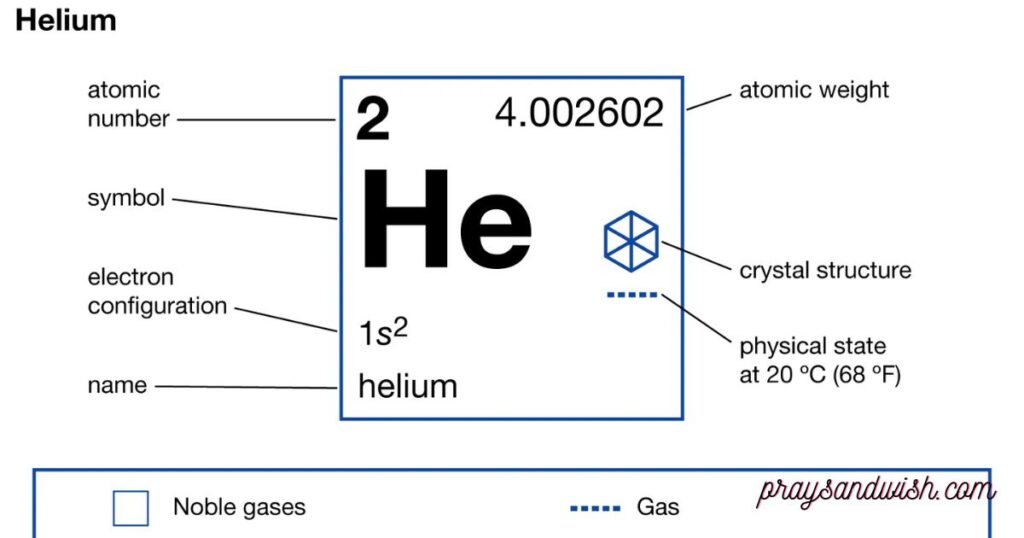
No, helonium is not a chemical element.
This is one of the biggest misunderstandings about the term.
A chemical element is a substance that contains only one type of atom. Examples include:
- Hydrogen (H)
- Helium (He)
- Oxygen (O)
- Carbon (C)
Each element has its own place on the periodic table.
Helonium does not appear on the periodic table because it is not an element. It is a chemical ion made from two different elements: helium and hydrogen.
A simple comparison:
| Helium | Helonium |
| Chemical element | Molecular ion |
| Symbol: He | Formula: HeH⁺ |
| Found on the periodic table | Not on periodic table |
| One type of atom | Two types of atoms |
| Neutral charge | Positive charge |
So, calling helonium an element would be incorrect. It is a unique chemical structure, not a new element.
Helonium vs Helium: What Is the Difference?
Many people confuse helonium with helium because both words start with “heli.” However, they are completely different scientific terms.
Helium is a chemical element, while helonium is a molecular ion made from helium and hydrogen.
Helium is one of the most common noble gases. It is famous for filling balloons and being used in scientific equipment. Helium atoms are very stable because they have a complete outer electron shell.
Helonium, on the other hand, is created when a helium atom combines with a hydrogen ion. This creates the chemical formula HeH⁺.
The main differences are:
| Feature | Helium | Helonium |
| Type | Chemical element | Molecular ion |
| Formula | He | HeH⁺ |
| Made of | Only helium atoms | Helium + hydrogen |
| Charge | No charge | Positive charge (+1) |
| Periodic table | Yes | No |
| Common uses | Balloons, cooling, research | Scientific research only |
A simple way to remember:
Helium is a single element. Helonium is a special combination of helium and hydrogen.
Although helium usually avoids chemical reactions, helonium proves that helium can form a bond under special conditions.
How Is Helonium Formed? Understanding HeH⁺ Formation
Helonium forms when helium and hydrogen interact under specific conditions. The process is not something that happens easily in normal daily environments.
The basic reaction is:
He + H⁺ → HeH⁺
This means:
- A helium atom (He) meets a hydrogen ion (H⁺)
- They combine together
- A positively charged helonium ion (HeH⁺) is created
Scientists call this process chemical bonding. However, because helium is a very stable element, creating helonium requires special conditions.
Formation in the Laboratory
Scientists can create helonium in laboratories using advanced equipment. The first successful production happened in 1925 when researchers studied reactions between helium and hydrogen.
Modern scientists use special tools to create and observe HeH⁺, including:
- Ion sources
- Spectroscopy equipment
- High-energy laboratory systems
These methods help researchers understand how this unusual molecule behaves.
Formation in Space
Helonium is also formed naturally in space.
Scientists believe that helonium appeared during the early stages of the universe when the first atoms were forming. At that time, the universe contained large amounts of hydrogen, helium, and energy.
A common formation process is:
Helium + Hydrogen ion → Helonium + Energy
This reaction helped create some of the first chemical structures after the Big Bang.
Because of this, scientists consider helonium an important part of the history of cosmic chemistry.
When Was Helonium Discovered? History and Scientific Background
The history of helonium goes back almost 100 years.
Scientists first created and identified the helium hydride ion in 1925. Researchers Thorfinn R. Hogness and E. G. Lunn produced HeH⁺ during laboratory experiments involving helium and hydrogen.
This discovery was surprising because helium was always known as an element that rarely reacts with other substances.
For many years, scientists believed that helonium could exist in space, but they could not directly find it.
The Space Discovery in 2019
A major breakthrough happened in 2019.
Scientists using NASA’s SOFIA (Stratospheric Observatory for Infrared Astronomy) detected helonium in a planetary nebula called NGC 7027.
This was important because:
- Scientists had predicted helonium existed in space.
- Laboratory experiments had already created it.
- But direct observation in space was missing.
The 2019 discovery confirmed that helonium is not just a laboratory creation. It is a real chemical species found in the universe.
This discovery helped scientists better understand how chemistry developed after the early universe began.
Helonium in Space: Why Scientists Study This Ion

Helonium is extremely important in astronomy because it gives scientists information about the early universe.
After the Big Bang, the universe was very hot and full of simple atoms. As it cooled down, atoms started combining and creating the first chemical compounds.
Helonium was one of the earliest molecules expected to form.
Scientists study helonium in space because it helps answer questions like:
- How did the first chemical reactions happen?
- How did the universe create more complex molecules?
- What conditions existed in early cosmic environments?
Helonium has been detected in places such as planetary nebulae, where hot gases create conditions suitable for this ion to exist.
Although helonium does not last forever, its short existence provides valuable information about the chemistry of stars and space.
Why Is Helonium Important in Astronomy and the Early Universe?
Helonium is important because it may have played a role in the first steps of cosmic chemistry.
In the early universe, there were no planets, stars, or life forms. There were only simple atoms and energy. Scientists believe helium was among the first molecular structures created after atoms began interacting.
It helped create a path toward more complex molecules, especially molecular hydrogen (H₂).
Molecular hydrogen is important because it helped cool clouds of gas and allowed the first stars to form.
Scientists often describe helium as a chemical time capsule because studying it helps us look back at the early stages of the universe.
Its importance is not because humans use it every day. Its value comes from the information it provides about:
- The birth of chemical reactions
- The development of the universe
- The formation of the first stars
Does Helonium Exist Naturally on Earth?
Yes, helonium can exist on Earth, but it does not naturally collect or stay stable in normal conditions.
Unlike helium gas, which can be stored in tanks and used for many purposes, helonium is a very reactive ion. It usually exists only for a short time under special conditions.
On Earth, scientists can create helonium inside laboratories using advanced equipment. However, you will not find helonium floating in the air, inside oceans, or as a common material around us.
The reason is simple: helonium quickly reacts with other particles and loses its structure.
Scientists mainly observe helonium in:
- Research laboratories
- High-energy environments
- Plasma experiments
- Specialized scientific studies
In space, helonium is easier to find because certain areas have the right conditions for it to form and survive longer.
So, the simple answer is:
Helonium exists on Earth only under controlled conditions, but it naturally appears in some areas of space.
Chemical Properties of Helonium (HeH⁺)
Helonium has some unusual chemical properties that make it interesting to scientists.
The chemical formula of helonium is:
HeH⁺
This formula tells us that it contains:
- One helium atom (He)
- One hydrogen atom (H)
- One positive charge (+)
Because it contains two different atoms, scientists classify helonium as a heteronuclear diatomic molecular ion.
This may sound complicated, but it simply means:
- Diatomic = made of two atoms
- Heteronuclear = the atoms are from different elements
- Molecular ion = a group of atoms with an electrical charge
Important Chemical Properties of Helonium
| Property | Description |
| Chemical formula | HeH⁺ |
| Charge | +1 |
| Type | Molecular ion |
| Number of atoms | Two |
| Elements included | Helium and hydrogen |
| Scientific name | Helium hydride ion |
One of the most interesting things about helonium is that it contains helium.
Helium is known as a noble gas, meaning it usually does not react with other elements. However, under special conditions, helium can form a bond with hydrogen.
This makes helonium an important example in chemistry because it shows that even very stable elements can create unusual chemical structures.
Physical Properties and Behavior of Helonium
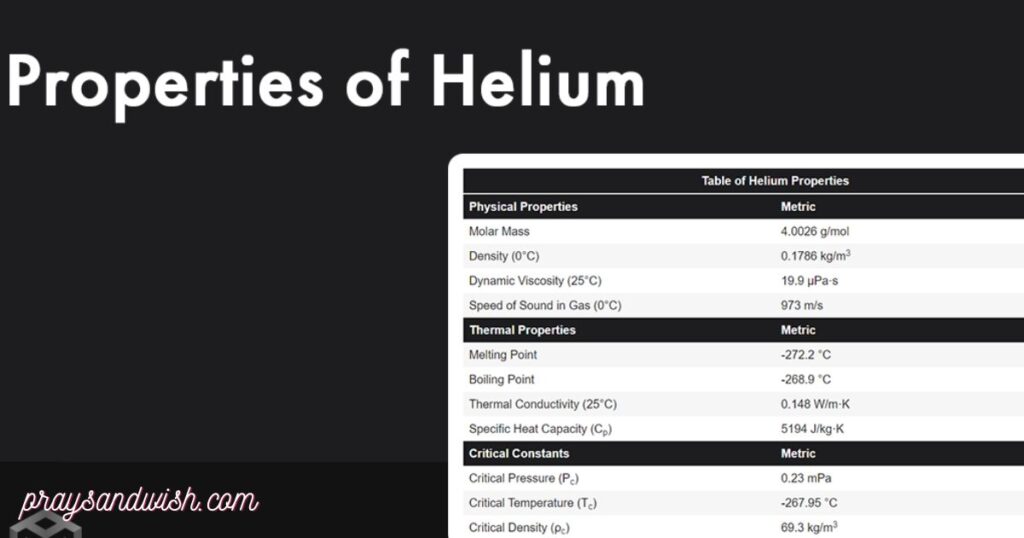
Helonium behaves very differently from common substances like water, oxygen, or helium gas.
It is not something that can be placed in a bottle or used like an everyday material. Instead, it exists as a tiny charged particle under special conditions.
Some important physical properties of helonium include:
| Property | Details |
| Formula | HeH⁺ |
| Charge | Positive (+1) |
| Mass | About 5.01 g/mol |
| Structure | Two connected atoms |
| State | Molecular ion |
| Stability | Short-lived and highly reactive |
Because helonium has a positive charge, it easily reacts with other particles. This makes it difficult to store or use in normal environments.
Scientists study its behavior using special methods such as spectroscopy. Spectroscopy helps researchers understand molecules by studying how they interact with light.
The unusual behavior of helonium helps scientists learn more about:
- Chemical bonding
- Molecular reactions
- Space chemistry
- The behavior of ions
What Are the Uses of Helonium?
Helonium does not have common everyday uses like helium. You will not find it in balloons, medical equipment, or industrial products.
Instead, its value comes from scientific research.
The main uses and importance of helonium include:
1. Astronomy Research
Scientists use helonium to study space environments.
Because helonium forms in certain cosmic conditions, finding it helps researchers understand:
- Hot gases in space
- Planetary nebulae
- Chemical reactions around stars
The discovery of helonium in space helped confirm scientific predictions about how molecules form in the universe.
2. Studying Early Universe Chemistry
Helonium helps scientists understand the first chemical reactions after the Big Bang.
Researchers study it because it may have been one of the earliest molecules formed when the universe was young.
It gives clues about:
- How atoms started combining
- How the first molecules appeared
- How complex chemistry developed
3. Laboratory Chemistry
Scientists study helonium in laboratories to learn more about:
- Chemical bonding
- Molecular ions
- Proton transfer reactions
- Quantum chemistry
Because helonium is a simple molecule with only two atoms, it is useful for testing scientific theories.
Is Helonium Used in Medicine or Industry?
No, helonium does not have major medical or industrial uses.
Some people confuse helonium with helium because of their similar names. However, they have very different properties.
Helium Uses
Helium is widely used in:
- Balloons
- MRI machines
- Cooling systems
- Scientific equipment
- Leak detection
Helonium Uses
Helonium is mainly used for:
- Scientific research
- Astronomy studies
- Chemistry experiments
The reason helonium is not used commercially is that it is:
- Highly reactive
- Difficult to store
- Not stable under normal conditions
So, while helium has many practical applications, helonium is mainly important for understanding science and the universe.
Helonium Pronunciation, Synonyms, and Common Names
Many people search for helonium pronunciation because the word looks unusual and can be difficult to say.
Some words and abbreviations can have multiple meanings depending on where they are used. Similar searches like TW meaning also show why understanding the context of a term is important.
The common pronunciation of helonium is:
Heh-LOH-nee-um
The stress is usually placed on the second part of the word:
he-LON-i-um
Breaking it into smaller parts makes it easier:
- He → sounds like “hee” or “heh”
- lon → sounds like “lon”
- ium → sounds like “ee-um”
However, scientists often use other names instead of the word “helonium.”
Common names for helonium include:
| Name | Meaning |
| Helonium | Common name for HeH⁺ |
| Helium hydride ion | Most common scientific name |
| HeH⁺ | Chemical formula |
| Hydridohelium(1+) | Systematic chemical name |
| Helium hydride cation | Another scientific term |
When reading scientific articles, you may see HeH⁺ more often than the word helonium.
This is because scientists usually prefer exact chemical names and formulas when discussing molecular ions.
Why Is Helonium Often Confused With Helium?
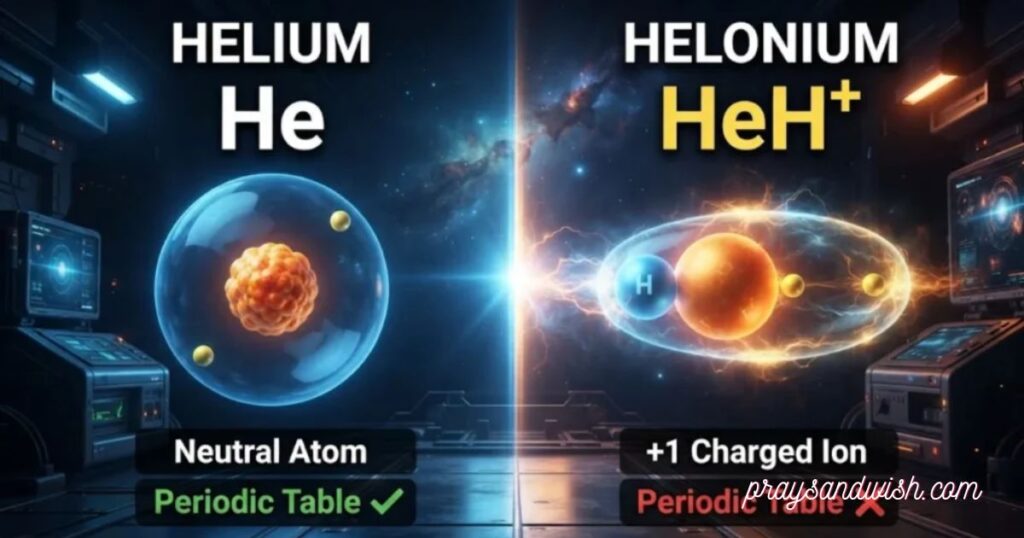
The confusion between helonium and helium happens because their names are very similar.
Both words contain the word “helium”, which makes many people think they are the same thing. However, they describe completely different substances.
Before understanding any unfamiliar term, people often try to gauge interest by looking at how others search for and discuss that topic online.
The main reason for confusion is:
- Helium is a famous element.
- Helonium contains helium but is not helium.
- Both names sound related.
Let’s make the difference simple:
Helium:
- A chemical element
- Found on the periodic table
- Has the symbol He
- A stable noble gas
Helonium:
- A molecular ion
- Made of helium and hydrogen
- Has the formula HeH⁺
- Has a positive electrical charge
A simple example:
Think of helium as a single building block. Helonium is like two different blocks joined together to create something new.
The presence of helium in its name does not mean they have the same properties.
Common Misconceptions About Helonium
Because helonium is not a common everyday term, many misunderstandings exist about it.
Here are some of the most common myths explained:
1. Helonium Is a New Chemical Element
False.
Helonium is not an element and does not have a place on the periodic table.
It is a molecular ion made from:
- One helium atom
- One hydrogen atom
Only substances made from one type of atom are called elements.
2. Helonium and Helium Are the Same Thing
False.
Although the names are similar, they are different.
Helium is a gas used in many industries, while helonium is a charged molecule mainly studied by scientists.
3. Helonium Is a Gas Like Helium
False.
Helium is a gas that can be collected and stored.
Helonium is not a normal gas. It exists as a small charged particle and is usually found only in special conditions.
4. Helonium Is a Fictional Substance
False.
Helonium is real.
Scientists first created it in laboratories in 1925 and later confirmed its presence in space in 2019.
5. Helonium Has Many Commercial Uses
False.
Helonium is important for research, but it does not have common industrial uses like helium.
Its value comes from helping scientists understand chemistry and the universe.
Key Facts About Helonium You Should Know
Here are the most important facts about helonium in one place:
- Helonium is the helium hydride ion (HeH⁺).
- It is made from one helium atom and one hydrogen atom.
- It has a positive electrical charge (+1).
- It is a molecular ion, not a chemical element.
- It does not appear on the periodic table.
- Scientists first produced it in a laboratory in 1925.
- It was first detected in space in 2019.
- NASA’s SOFIA observatory helped confirm its existence in the planetary nebula NGC 7027.
- Helonium is important for studying the early universe.
- It helps scientists understand how the first chemical reactions happened.
- It has no major medical or industrial applications.
- Scientists usually refer to it as HeH⁺ or the helium hydride ion.
Conclusion:
Helonium is a unique scientific term that may sound confusing at first, but its meaning is simple. Helonium is the helium hydride ion (HeH⁺), a small molecule made from helium and hydrogen. It is not a new element, and it is not the same as helium.
Scientists study helonium because it helps them understand chemical reactions, space, and the early history of the universe. Although helonium does not have everyday uses, it has great scientific importance. From its discovery in laboratories to its detection in space, helonium shows how even tiny particles can reveal amazing secrets about our universe.
Frequently Asked Questions About Helonium
What does helonium mean?
Helonium means the helium hydride ion (HeH⁺), which is a molecule made from helium and hydrogen.
Is helonium a chemical element?
No, helonium is not an element. It is a special molecular ion and does not appear on the periodic table.
Is helonium the same as helium?
No, helium is an element, while helonium is a molecule made from helium and hydrogen.
Where is helonium found?
Helonium can be created in laboratories and has also been found in space, especially in areas like planetary nebulae.
Does helonium have any practical uses?
Helonium does not have common daily uses. Scientists mainly study it to learn more about chemistry and the universe.