TW Meaning in Text: Trigger Warning Meaning, Uses, and Examples
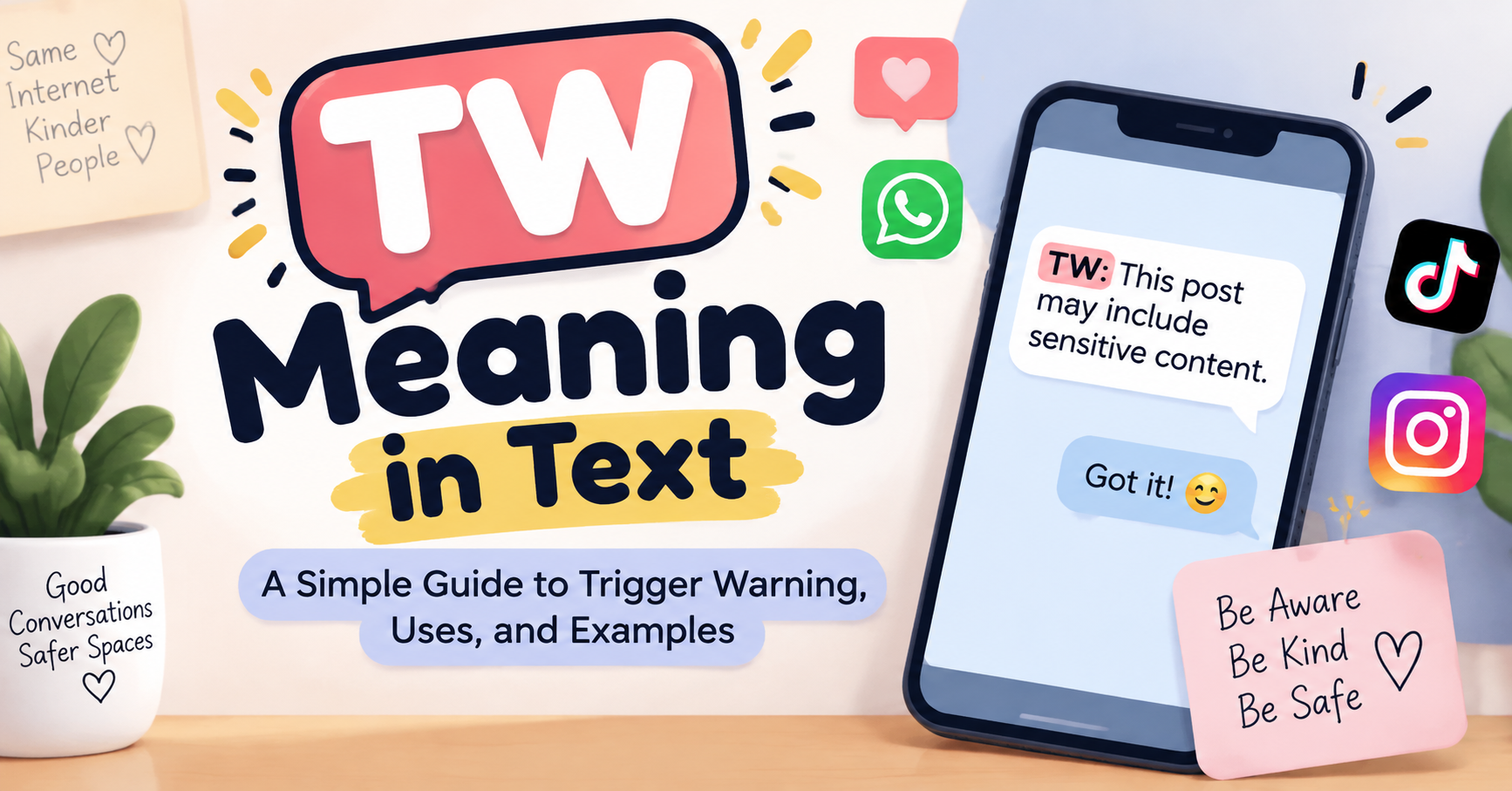
Have you ever seen TW before a message, TikTok video, or Instagram post and wondered what it means? This small abbreviation is common in online chats, but many people are still confused about its real meaning. The most common TW meaning in text is Trigger Warning, which helps people know that sensitive content is coming. It gives readers a choice before they view topics that may be emotional or difficult.
In this guide, you will learn what TW stands for, why people use it, where it came from, and how it is used on social media.
Table of Contents
What Does TW Mean in Text? Complete Explanation
The most common TW meaning in text is:
TW = Trigger Warning
A trigger warning is a short message placed before sensitive content. It tells readers that the next part may include topics that could be difficult or uncomfortable for some people.
For example:
TW: Anxiety and panic attacks
This means the post may talk about anxiety or panic attacks, and readers can choose whether they want to continue.
People use TW to show care and respect for others. It allows someone to prepare themselves before seeing content that may affect their emotions.
TW is commonly used before posts about:
- Mental health
- Trauma
- Violence
- Abuse
- Death
- Serious illnesses
- Other sensitive topics
The main purpose of TW is simple:
It gives people a choice before they view difficult content.
TW Full Form and Meaning: What Does TW Stand For?
The TW full form is:
TW = Trigger Warning
The word “trigger” refers to something that may cause a strong emotional reaction. A “warning” means giving someone information before something happens.
Together, Trigger Warning means:
A notice that prepares people for sensitive or upsetting content.
For example:
TW: Discussion of grief and loss
This tells readers that the content may talk about death or losing someone.
TW is not meant to stop people from discussing important topics. Instead, it helps people approach those topics with awareness.
Many online communities use TW because people have different experiences. Something that feels normal to one person may be difficult for another person.
TW Meaning in WhatsApp, Instagram, TikTok, and Social Media
The TW meaning in WhatsApp, Instagram, and TikTok is usually the same: Trigger Warning.
People use TW on social media before sharing personal stories, videos, or posts that may be emotionally difficult.
TW Meaning in WhatsApp
On WhatsApp, people often use TW in group chats or private messages.
Example:
“TW: This message talks about a difficult personal experience.”
It helps friends know that the message contains a serious topic.
TW Meaning on Instagram
On Instagram, TW is commonly used in:
- Captions
- Stories
- Reels descriptions
- Posts
Example:
“TW: Eating disorder recovery story.”
This warns viewers before they read the post.
TW Meaning on TikTok
On TikTok, creators often add TW before videos about sensitive subjects.
Examples:
- Personal struggles
- Mental health stories
- Emotional experiences
A creator may write:
“TW: This video discusses anxiety.”
This gives viewers the option to skip the video if they prefer.
TW Meaning on Other Social Media Platforms
TW is also common on:
- Discord
- Tumblr
- X (Twitter)
Different communities use TW to create a safer and more respectful online environment.
Why Do People Use TW in Text Messages and Online Chats?
People use TW in text messages and online chats to give others a warning before sharing sensitive information. It is a simple way to show kindness and respect toward other people’s feelings.
When someone adds TW before a message, they are basically saying:
“This topic may be difficult for some people, so please read only if you feel comfortable.”
TW helps readers make their own choice. They can continue reading, skip the content, or come back later when they feel ready.
TW as a Sign of Respect
Many people use TW because they understand that everyone has different experiences.
For example:
A person sharing a story about a difficult event may write:
“TW: Loss of a family member.”
This does not mean people cannot talk about the topic. It simply gives readers a moment to prepare themselves.
TW in Personal Messages
In private chats, friends may use TW before sharing something serious.
Example:
“TW: I want to talk about a stressful experience from my past.”
This helps the other person understand that the conversation may be emotional.
TW in Online Communities
Many online communities use TW because people from different backgrounds come together in one place.
You may see TW in:
- Support groups
- Mental health communities
- Discussion forums
- Social media pages
It creates a more thoughtful online space where people can choose what content they want to view.
TW Meaning in Gen Z Slang and Internet Culture
The TW meaning in Gen Z slang is still mostly Trigger Warning.
Gen Z users often use short words and abbreviations to communicate quickly online. TW became popular because it is short, easy to understand, and useful in digital conversations.
For many young internet users, TW is a normal part of online communication.
Why Gen Z Uses TW Online
Gen Z often discusses topics like:
- Mental health
- Personal struggles
- Social issues
- Life experiences
Because these topics can be emotional, TW helps create awareness before sharing them.
Example:
“TW: Mental health discussion.”
This tells people that the content may include serious information.
TW and Modern Internet Culture
Online culture has changed the way people communicate. Short terms like:
- TW (Trigger Warning)
- CW (Content Warning)
- POV (Point of View)
- IRL (In Real Life)
have become common in digital conversations.
TW is popular because it combines two things:
- Quick communication
- Consideration for others
Where Did TW Come From? History and Origin of Trigger Warning
The idea behind Trigger Warning started before social media.
The concept came from discussions about trauma and mental health. Experts noticed that certain topics, memories, or images could cause strong emotional reactions for some people.
Over time, the idea moved from professional discussions into online communities.
How TW Became Popular Online
In the early days of online forums, people started using warnings before sharing sensitive topics.
Communities discussing subjects like:
- Trauma
- Abuse
- Mental health
- Eating disorders
began adding warnings to help readers.
Later, platforms like Tumblr, Reddit, Twitter, Instagram, and TikTok helped make TW common.
Today, TW is widely recognized as an internet abbreviation.
Why Trigger Warning Became Important
The main purpose of TW has always been the same:
To give people information before they see difficult content.
It allows users to decide what they are comfortable viewing.
TW vs CW: What Is the Difference Between Trigger Warning and Content Warning?
Many people confuse TW and CW because they are both used before sensitive content.
Although they are similar, there is a small difference.
TW (Trigger Warning)
TW means Trigger Warning.
It is usually used for content that may remind someone of a traumatic experience.
Examples:
- Abuse
- Violence
- Self-harm
- Severe trauma
- Eating disorders
Example:
“TW: Discussion of domestic violence.”
CW (Content Warning)
CW means Content Warning.
It is a broader warning for content that may be uncomfortable but not necessarily connected to trauma.
Examples:
- Strong language
- Political discussions
- Spoilers
- Difficult topics
Example:
“CW: This post contains strong opinions about politics.”
Simple Difference Between TW and CW
You can remember it like this:
TW = More specific and often related to trauma
CW = General warning about sensitive content
However, many people use these terms interchangeably online.
Common Topics That Use a TW Warning
Not every post needs a TW warning. People usually use TW when the content may be emotionally difficult, upsetting, or connected to a serious experience.
The purpose of TW is not to stop conversations. It is only a way to give people a choice before they see sensitive information.
Some common topics that often include a TW warning are:
Mental Health Topics
People may add TW before posts about:
- Depression
- Anxiety
- Panic attacks
- Suicidal thoughts
- Mental health struggles
Example:
“TW: Discussion about depression and recovery.”
This lets readers know the topic may be emotional.
Trauma and Abuse
TW is commonly used before discussions about:
- Physical abuse
- Emotional abuse
- Sexual assault
- Past trauma
Example:
“TW: This post discusses personal trauma.”
The warning helps people prepare before reading.
Death and Loss
People may use TW before sharing stories about:
- Losing a loved one
- Grief
- Serious accidents
- Death-related topics
Example:
“TW: Talking about the loss of a family member.”
Eating Disorders and Body Image
Some posts about food, weight, or body image may include TW.
Examples:
- Eating disorder recovery
- Extreme dieting
- Body image struggles
Example:
“TW: Eating disorder discussion.”
Violence and Disturbing Content
TW may also appear before content involving:
- Violence
- Injuries
- Graphic events
- Crime stories
Example:
“TW: Description of a violent event.”
Discrimination and Social Issues
Some people use TW before discussing:
- Racism
- Hate speech
- Harassment
- Discrimination
This helps readers understand the topic before continuing.
Does TW Have Other Meanings in Text?
Yes, TW can have different meanings depending on the context.
While the most common TW meaning in text is Trigger Warning, it is not the only meaning.
The meaning depends on where you see it and how it is used.
For example:
- A social media post → Usually means Trigger Warning
- A work message → May mean This Week
- An older online conversation → Could refer to Twitter
Always look at the full sentence before deciding what TW means.
TW Other Meanings: Twitter, This Week, and More
Although Trigger Warning is the most common meaning online, TW can represent other phrases too.
Here are some other meanings:
TW Meaning: Twitter
In some older online conversations, people used TW as a short form for Twitter.
Example:
“I saw it on TW yesterday.”
Meaning:
“I saw it on Twitter yesterday.”
However, this use is less common today because people usually write “X” instead of Twitter.
TW Meaning: This Week
In work and business conversations, TW can sometimes mean This Week.
Example:
“Please complete the report by TW Friday.”
Meaning:
“Please complete the report by this week’s Friday.”
The meaning depends on the workplace and conversation. Also read more: Gramhir Pro AI Image Generator
TW Meaning in Sports
In some sports contexts, TW may have different meanings depending on the game or organization.
For example, it can be used as an abbreviation for certain terms or positions.
How to Know the Correct Meaning of TW
The easiest way is to check the context.
Ask:
- Is it a social media post?
- Is it a work message?
- Is it a sports discussion?
- Is it a personal chat?
The sentence around TW usually makes the meaning clear.
Real-Life Examples of TW in Text Messages and Social Media
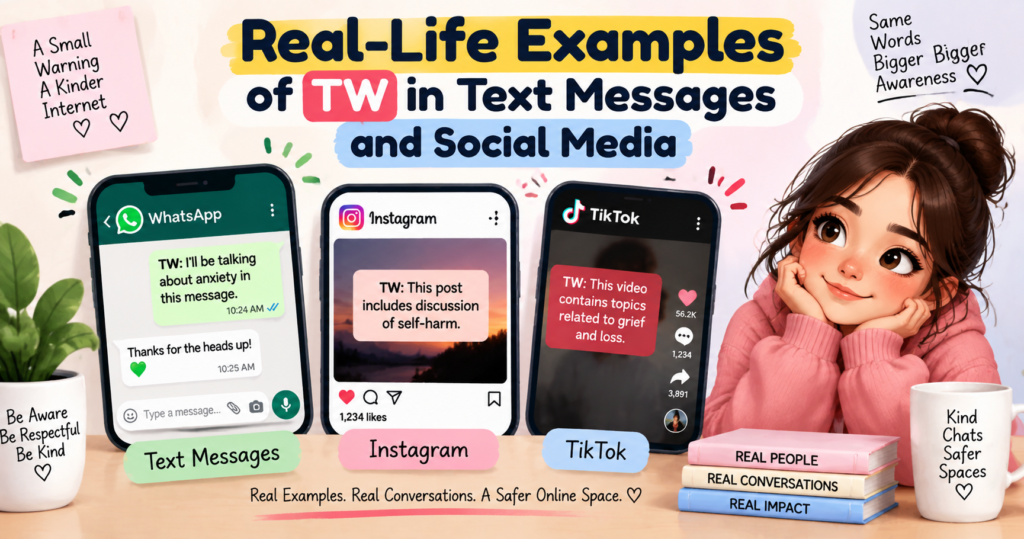
Seeing examples makes it easier to understand how people use TW online.
Here are some common examples:
Example 1: Instagram Post
“TW: Mental health discussion. Sharing my experience with anxiety.”
Meaning:
The post talks about anxiety, so the creator gives readers a warning first.
Example 2: TikTok Video
“TW: This video talks about panic attacks.”
Meaning:
Viewers are informed that the video contains a sensitive topic.
Example 3: WhatsApp Message
“TW: I need to talk about something difficult that happened today.”
Meaning:
The sender is preparing the other person for a serious conversation.
Example 4: Reddit Post
“TW: Grief and loss. I want to share my personal story.”
Meaning:
The writer is warning readers about an emotional topic.
Example 5: Discord Chat
“TW: Self-harm discussion. Please skip if this topic affects you.”
Meaning:
The person is giving others the option to avoid the content.
TW is usually placed before the sensitive information, not after it.
The goal is simple:
Give people a choice before they see something difficult.
How to Use TW Correctly (Best Practices and Mistakes to Avoid)
Using TW correctly is important because the main purpose of a trigger warning is to help people understand what they are about to see or read.
A good TW should be clear, simple, and placed before the sensitive content.
Here are some best practices for using TW:
Put TW at the Beginning of the Post
The most important rule is to place TW before the sensitive information.
Correct example:
“TW: Discussion of anxiety and panic attacks. I want to share my personal experience…”
Incorrect example:
“I had a panic attack last year. TW.”
The warning should come before the topic, not after it.
Be Specific About the Topic
A simple “TW” may not give enough information.
Instead of writing:
“TW: Sensitive topic”
Try to be more specific:
“TW: Discussion of grief and loss.”
This helps people decide if they want to continue reading.
Give Readers Space Before the Content
Many people add a few lines or spaces after the warning.
Example:
TW: Violence discussion
Main content starts here
This gives readers time to stop if they do not want to continue.
Use TW for Real Sensitive Topics
TW should be used when the topic may seriously affect someone emotionally.
Good examples:
- Trauma
- Abuse
- Violence
- Mental health struggles
- Self-harm discussions
Using TW for every small problem can reduce its importance.
Common Mistakes People Make With TW
Even though TW is simple, people sometimes use it incorrectly.
Here are common mistakes:
Mistake 1: Adding TW After the Content
A warning does not help if readers already saw the difficult information.
Bad example:
“I will talk about a traumatic event. TW.”
The warning came too late.
Better:
“TW: Discussion of a traumatic event.”
Mistake 2: Being Too General
Writing only:
“TW: Bad content”
does not help readers understand what is coming.
A better warning explains the topic.
Example:
“TW: Discussion of violence.”
Mistake 3: Using TW as a Joke
Some people use TW in a funny way:
“TW: I am about to share my unpopular opinion.”
This may confuse people because TW is normally used for serious topics.
Mistake 4: Using TW Too Often
Not every uncomfortable topic needs a trigger warning.
Using TW for everything may make people ignore important warnings.
The best approach is:
Use TW when it is actually helpful.
Should You Always Use TW? When Is It Necessary?
No, you do not need to use TW for every post or message.
TW is not a rule. It is a way to show awareness and respect.
You should consider using TW when your content includes topics that may cause strong emotional reactions.
Examples:
- Personal trauma stories
- Abuse discussions
- Violence
- Serious mental health topics
- Self-harm discussions
- Disturbing experiences
When TW May Not Be Needed
You usually do not need TW for normal conversations or everyday topics.
Examples:
- A regular opinion
- A simple personal update
- A normal discussion
The goal of TW is not to avoid difficult conversations. The goal is to help people prepare before reading.
TW Meaning in Text vs Formal Writing
The use of TW in text messages and social media is very different from formal writing.
TW is mostly used in:
- Social media posts
- Online chats
- Forums
- Community discussions
It is short and easy to understand in casual online spaces.
TW in Professional Writing
In formal writing, people usually avoid abbreviations like TW.
Examples of formal alternatives:
- “Content Warning”
- “This article discusses sensitive topics.”
- “The following section contains difficult material.”
You may see full warnings in:
- Academic articles
- News reports
- Professional documents
- Educational materials
Why Formal Writing Uses Full Words
Professional writing is meant for a wider audience. Not everyone may know internet slang.
Using the full phrase makes the meaning clear for all readers.
For example:
Informal:
“TW: Discussion of trauma.”
Formal:
“Content warning: This section discusses traumatic experiences.”
Both have the same purpose, but the second one is more suitable for professional settings.
FAQ’s
What does TW stand for in text?
TW usually stands for “Trigger Warning.” It is used before sensitive content to warn readers about topics that may be upsetting.
What does TW mean on Instagram?
On Instagram, TW usually means Trigger Warning. Users add it before posts, stories, or reels that discuss sensitive topics.
What does TW mean on TikTok?
On TikTok, TW is used before videos that may include emotional or sensitive content. It helps viewers decide whether they want to watch.
Is TW the same as CW?
No. TW means Trigger Warning, while CW means Content Warning.
TW is usually more focused on trauma-related topics, while CW is a broader warning for sensitive content.
Can TW have other meanings?
Yes. Depending on the context, TW can also mean:
- This Week
- Other terms in specific fields
However, on social media, it most commonly means Trigger Warning.
Do I have to use TW?
No, it is not required. It is a helpful practice that allows people to choose whether they want to view sensitive content.
Why do people use TW?
People use TW to show respect, give a warning, and create a more thoughtful online environment.
Conclusion
The TW meaning in text is most commonly “Trigger Warning.” It is a simple abbreviation used online to warn people before sharing sensitive or emotional content. You may see TW on WhatsApp, Instagram, TikTok, Reddit, and other social media platforms. It helps readers prepare themselves before viewing topics that may be difficult or upsetting.
TW is not meant to stop conversations. Instead, it gives people a choice and shows consideration for different experiences. Now that you understand what TW means, its full form, examples, and correct usage, you can easily understand this common internet abbreviation whenever you see it online.