What Is the Biblically Accurate Satan? His True Role, Appearance & Meaning
What if the Satan people fear most is not the one shown in movies? The Bible gives a very different picture. It does not focus on red skin, horns, or a pitchfork. Instead, it shows Satan as a spiritual enemy who works through lies, doubt, temptation, and deception. He does not rule hell, and he is not equal to God.
His power has limits. In the Bible, Satan is also called the adversary, the accuser, the tempter, and the father of lies. This makes his real danger much harder to see. His biggest weapon is not how scary he looks, but how easily he can make false things look true. This guide explains the real biblical picture in simple words.
Table of Contents
What Is a Biblically Accurate Satan?
A biblically accurate Satan is the Satan described in Scripture, not the one shown in movies, cartoons, or popular art.
In the Bible, Satan is mainly shown as an adversary. The word “Satan” is linked with the idea of an opponent or accuser. In the Book of Job, Satan appears before God and questions Job’s faith.
Satan is also shown as a tempter and deceiver. He tries to move people away from truth and obedience to God.
The Bible does not mainly focus on what Satan looks like. It focuses more on what Satan does.
Understanding the Biblically Accurate Satan in Scripture
The Bible describes Satan in different ways across the Old and New Testaments.
In the Old Testament, Satan often appears as an accuser or tester. In Job, he questions Job’s motives and is allowed to test him within limits.
In the New Testament, Satan is shown more clearly as an enemy of God’s purposes. He tempts Jesus, deceives people, and works against faith.
The Hebrew Concept of Ha-Satan
The Hebrew term often translated as Satan is connected with the meaning “adversary” or “accuser.”
In some early passages, the word may describe a role instead of a personal name.
For example, in Job, Satan appears in a heavenly court setting. His role is similar to an accuser who raises questions about Job’s faith.
Satan’s Transformation Across Biblical Texts

The way Satan is presented becomes clearer over time.
In Job, he acts only within limits set by God.
In later biblical texts, Satan becomes more clearly connected with deception, spiritual opposition, temptation, and evil.
Biblical names often carry a deeper meaning, just like the Roman Meaning can reveal the history behind a name.
In the New Testament, he becomes a major spiritual enemy who stands against Jesus and the message of God.
Distinct Roles Across Old and New Testaments
| Testament | Main Role of Satan | Example |
| Old Testament | Accuser and tester | Job 1–2 |
| Old Testament | Opponent | Zechariah 3 |
| New Testament | Tempter | Matthew 4 |
| New Testament | Deceiver | John 8:44 |
| New Testament | Spiritual enemy | 1 Peter 5:8 |
The Old Testament gives a more limited picture. The New Testament gives a wider picture of Satan’s role.
What Does Satan Look Like? Biblically Accurate Appearance Explained
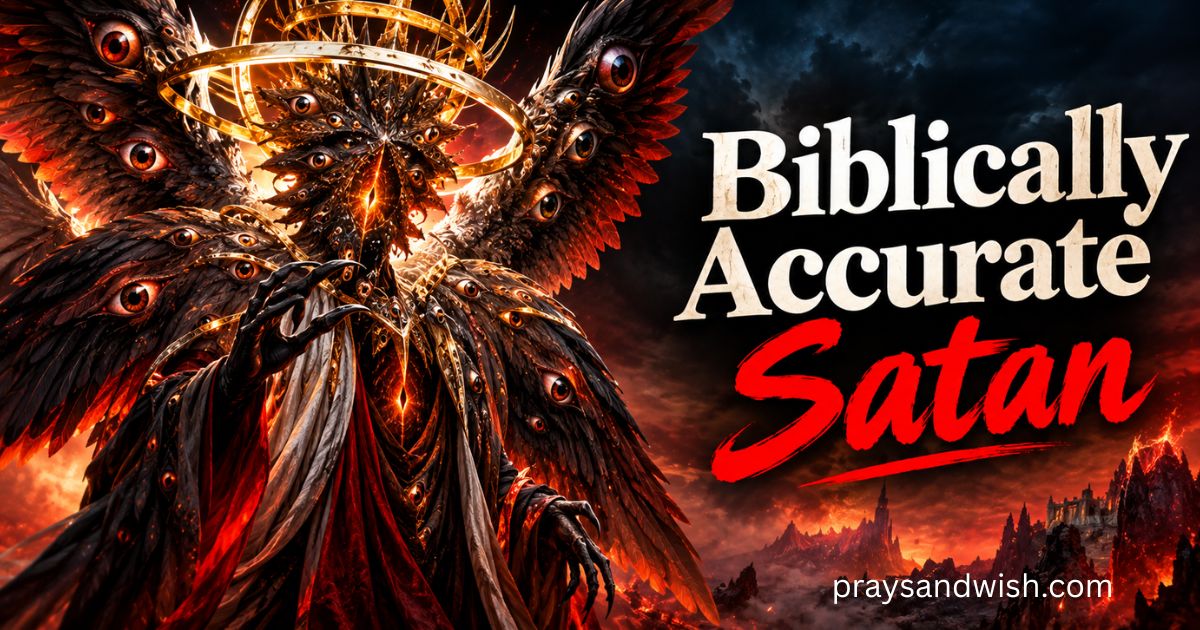
The Bible never says Satan has red skin, horns, a tail, or a pitchfork.
Those images came later through art, stories, and culture.
The Bible uses symbols and metaphors instead of giving one clear physical description.
Satan is compared with a serpent, a dragon, a lion, and even an angel of light.
These images describe his character and actions more than his body.
Main Biblical Images of Satan
| Image | Meaning |
| Serpent | Deception and cunning |
| Lion | Danger and attack |
| Dragon | Great spiritual opposition |
| Angel of light | False appearance of goodness |
The strongest lesson is simple. Satan may not always appear frightening. The Bible warns that deception can look attractive or even good.
Is Satan Evil in the Bible?
Yes, the Bible presents Satan as working against truth, faith, and God’s purposes.
Jesus calls the devil a liar and the “father of lies” in John 8:44.
Satan also tempts people to sin and tries to pull them away from God.
However, the Bible also makes it clear that Satan is not equal to God. He cannot act without limits.
Is Satan the Devil According to the Bible?
The Bible uses both “Satan” and “the devil” for the same spiritual enemy in many New Testament passages.
The word Satan points to the idea of an adversary or accuser.
The word devil is linked with slander, accusation, and false charges.
Revelation 12:9 connects several titles. It describes the great dragon, the ancient serpent, the devil, and Satan as the same enemy.
Is Satan Real According to Scripture?
The Bible treats Satan as a real spiritual being.
He speaks, tempts, accuses, deceives, and acts with purpose.
Jesus speaks directly to Satan during the temptation in the wilderness.
The New Testament also warns believers to resist the devil and stay alert.
Some modern people interpret Satan only as a symbol of evil. However, the biblical texts usually speak of Satan as a personal spiritual agent.
Where Did Satan Come From in the Bible?
The Bible does not give one single chapter that fully explains Satan’s origin.
Instead, people build the traditional view from several passages.
Luke 10:18 says Jesus saw Satan fall like lightning from heaven.
Revelation 12 describes a dragon being cast down from heaven.
Other passages speak about angels who sinned and were judged.
Because of these texts, many Christians believe Satan was originally a heavenly being who rebelled against God.
Was Satan Originally an Angel?
The traditional Christian view says yes.
Many Christians believe Satan was once an angel who rebelled against God.
This view is often connected with Luke 10:18, Revelation 12, Jude 6, and 2 Peter 2:4.
However, the Bible does not give one simple sentence saying, “Satan was once an angel named Lucifer.”
This idea comes from combining several passages and later Christian interpretation.
Traditional View vs Alternative View
| View | Main Idea |
| Fallen angel view | Satan was created good but later rebelled |
| Created adversary view | Satan may have had an adversarial role from the beginning |
The fallen angel view is much more common in Christian teaching.
Biblically Accurate Angel vs Satan: What Is the Difference?
A biblically accurate angel is a spiritual servant of God.
Angels carry messages, worship God, protect, serve, and carry out divine commands.
Satan, by contrast, is shown as an adversary who deceives, tempts, and accuses.
The Bible does not present Satan as equal to the faithful angels who obey God.
Angel vs Satan
| Biblically Accurate Angel | Satan |
| Serves God | Opposes God’s purposes |
| Brings messages | Spreads deception |
| Obeys divine commands | Tempts people |
| Worships God | Seeks to lead people away |
The biggest difference is not appearance. It is loyalty and purpose.
Biblically Accurate God and Satan: What Does the Bible Teach?
The Bible does not present God and Satan as equal powers.
God is Creator.
Satan is a created spiritual being.
God is sovereign. Satan is limited.
In Job, Satan cannot test Job beyond the limits God allows.
This means the Bible is not teaching a battle between two equal gods.
God remains above Satan at every point.
Biblically Accurate Jesus and His Encounters With Satan
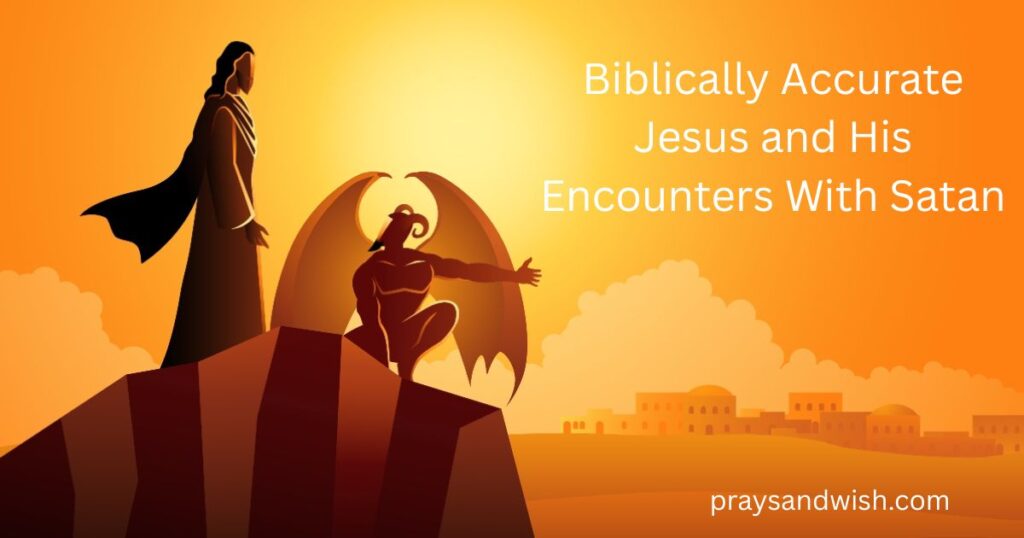
The New Testament shows several direct encounters between Jesus and Satan.
One of the clearest appears in Matthew 4.
Satan tempts Jesus in the wilderness.
He tries to use hunger, power, pride, and even Scripture to test Jesus.
Jesus answers with Scripture and refuses every temptation.
Jesus also speaks about Satan’s fall and teaches that Satan’s power will not last forever.
What Jesus Reveals About Satan
Jesus shows that Satan:
- Tempts people.
- Uses lies and half-truths.
- Can misuse Scripture.
- Wants worship and control.
- Can be resisted.
- Will be defeated.
Biblically Accurate Demon: What Does Scripture Actually Say?
The Bible describes demons as evil or unclean spirits.
They are shown as spiritual beings, not normal physical creatures.
In the New Testament, demons can oppress or possess people.
Jesus often casts them out and shows authority over them.
Many Christians believe demons are fallen angels who followed Satan.
However, the Bible does not give a full and simple explanation of their exact origin.
Satan and Demons
Satan is normally presented as the main spiritual adversary.
Demons are presented as lesser evil spirits connected with spiritual opposition.
They have power, but their power is limited.
They are never shown as equal to God.
Satan’s Names, Titles, and Symbols in the Bible
The Bible uses many titles and images for Satan.
Each title teaches something about his role.
| Name or Title | Meaning |
| Satan | Adversary |
| Devil | Slanderer or accuser |
| Serpent | Deceiver |
| Dragon | Powerful spiritual enemy |
| Tempter | One who tempts |
| Accuser | One who brings charges |
| Father of lies | Source of deception |
| Roaring lion | Dangerous enemy |
These names show that Satan’s main strength is often deception, accusation, and temptation.
What Powers Does Satan Have According to the Bible?
The Bible presents Satan as powerful, but not all-powerful.
He can tempt people.
He can deceive.
He can influence.
He can accuse.
He is also linked with spiritual opposition and evil.
However, he is never shown as all-knowing, all-present, or all-powerful.
Those qualities belong to God alone.
What Are Satan’s Limits According to Scripture?
This is one of the most important ideas in the Bible.
Satan has limits.
In Job, God tells Satan how far he can go.
Satan cannot simply do anything he wants.
The New Testament also teaches believers to resist the devil.
James 4:7 says that if people resist the devil, he will flee.
Satan’s Power vs Satan’s Limits
| Satan Can | Satan Cannot |
| Tempt | Become equal to God |
| Deceive | Act without limits |
| Accuse | Know everything |
| Attack spiritually | Be everywhere |
| Influence | Escape final judgment |
This helps readers understand Satan without giving him more power than the Bible gives him.
Why Is Satan Called the Father of Lies?
Jesus calls Satan the father of lies in John 8:44.
This title shows how central deception is to Satan’s role.
From Genesis onward, temptation often begins with twisting truth.
A lie may contain part of the truth.
That makes it more dangerous.
Satan does not always need to create a completely false idea. He can change, hide, or twist part of the truth.
This is why the Bible places such a strong focus on truth.
The Bible also gives examples of people who stayed strong in faith, such as the Caleb Story, which teaches courage and trust in God.
Is Lucifer Satan? What Isaiah 14 and Ezekiel 28 Really Say
This is one of the most debated questions about Satan.
The word “Lucifer” comes from a Latin translation of Isaiah 14:12.
The original Hebrew refers to a shining one or morning star.
Isaiah 14 directly speaks about the king of Babylon.
Because the language is grand and symbolic, many Christian teachers later connected it with Satan’s fall.
Isaiah 14 and Lucifer
Isaiah 14 describes a proud ruler who falls from a high place.
Some Christians see this as both a human king and a picture of Satan.
Other scholars say the passage is only about the king of Babylon.
Ezekiel 28 and Satan
Ezekiel 28 speaks about the ruler or king of Tyre.
It also uses unusual language about Eden, beauty, and a guardian cherub.
Because of this, many Christians believe the passage also points to Satan.
Others believe it is poetic language about a human king.
What Can We Say With Confidence?
| Question | Simple Answer |
| Is Lucifer directly named as Satan in the Bible? | No |
| Does Isaiah 14 use the word Lucifer in some translations? | Yes |
| Is Isaiah 14 directly about the king of Babylon? | Yes |
| Do many Christians connect it with Satan? | Yes |
| Is the interpretation debated? | Yes |
It is best to avoid saying more than the Bible clearly says.
Biblical Satan vs Popular Culture: What Is Actually Different?
Popular culture gives Satan a very strong visual image.
The Bible gives a very different one.
Biblical Satan vs Cultural Satan
| Biblical Picture | Popular Culture |
| Spiritual being | Red monster |
| Deceiver | Pitchfork-carrying ruler |
| Limited power | Almost equal to God |
| Does not rule hell | Often shown as king of hell |
| Can appear as light | Usually shown as frightening |
| Final judgment awaits him | Often shown controlling hell forever |
The biggest cultural mistake is the idea that Satan rules hell.
In the Bible, hell is not Satan’s kingdom.
It is a place of judgment.
Revelation describes Satan himself being judged.
What Does the Bible Say About Satan’s Final Defeat?
The Bible teaches that Satan’s future ends in defeat.
Revelation 20 describes Satan being judged and thrown into the lake of fire.
This means Satan does not win.
He does not rule forever.
He does not become king of hell.
The New Testament presents the work of Jesus as a major victory over evil.
Satan may still oppose and deceive, but his end is already shown.
Key Bible Verses About the Biblically Accurate Satan
Several passages are especially useful for understanding Satan.
Job 1–2
These chapters show Satan as an accuser and tester.
They also show that his power has limits.
Matthew 4:1–11
This passage shows Satan tempting Jesus.
It reveals how temptation can use hunger, pride, power, and even Scripture.
John 8:44
Jesus calls the devil a liar and the father of lies.
This verse shows that deception is central to Satan’s character.
Peter 5:8
Satan is compared with a roaring lion looking for someone to devour.
This image teaches believers to stay alert.
Corinthians 11:14
This verse says Satan can disguise himself as an angel of light.
It warns that evil does not always look evil.
Revelation 12
This chapter uses the image of a dragon and connects Satan with the ancient serpent and deceiver.
Revelation 20
This chapter describes Satan’s final judgment.
If you want to study more passages like these, explore these Bible Verses for simple and helpful biblical guidance.
Conclusion
The biblically accurate Satan is very different from the scary red figure shown in movies and art. The Bible does not focus on horns, a tail, or a pitchfork. Instead, it shows Satan as a spiritual enemy who uses lies, temptation, and deception. He is called the adversary, accuser, tempter, and father of lies. The Bible also makes it clear that Satan is not equal to God.
His power has limits, and he cannot act without boundaries. He does not rule hell, and his final future is judgment and defeat. Understanding the biblical picture helps readers separate Scripture from popular myths. The main lesson is simple: Satan’s greatest danger is not how he looks, but how he can make lies seem true.
FAQs
What does a biblically accurate Satan look like?
The Bible does not give one clear physical description of Satan. It uses symbols like a serpent, dragon, lion, and angel of light.
Is Satan the ruler of hell?
No. The Bible does not show Satan ruling hell. It shows that he will face judgment there.
Was Satan once an angel?
Many Christians believe Satan was once a heavenly being who rebelled against God. This view comes from several Bible passages.
Why is Satan called the father of lies?
Jesus used this title because Satan is strongly linked with deception, false ideas, and leading people away from truth.
Is Satan as powerful as God?
No. The Bible shows that Satan has power, but it is limited. God is greater and remains fully in control.